
18 MAY 2026
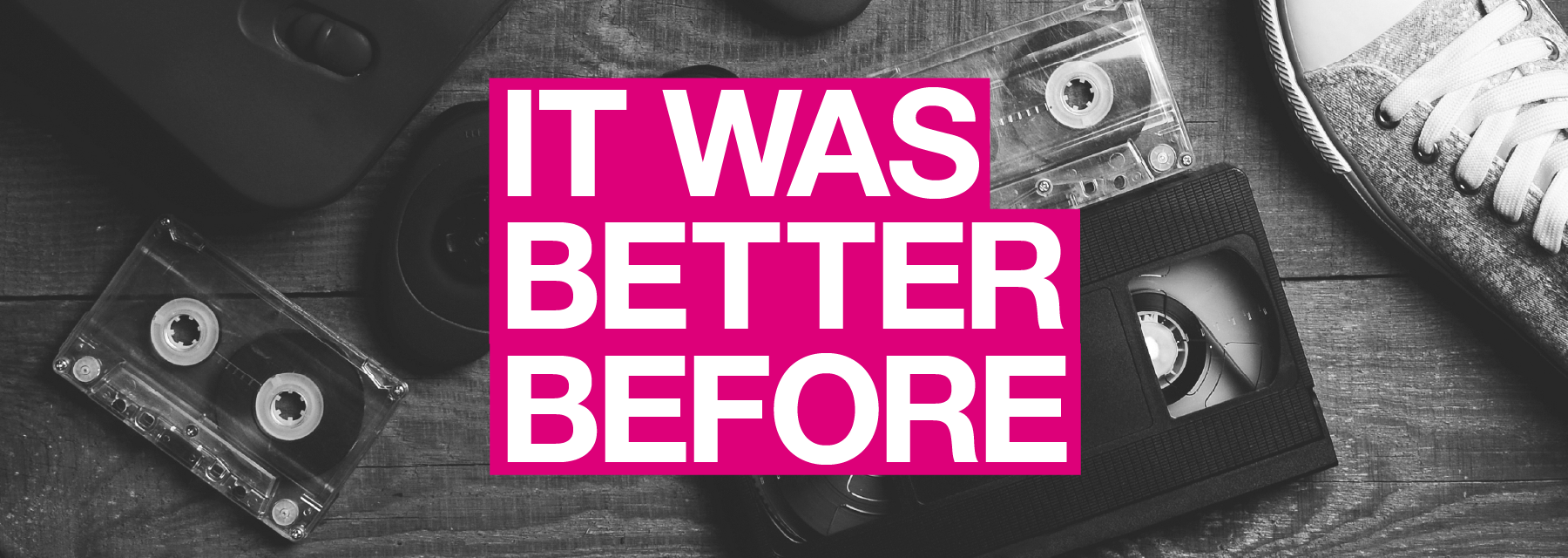
The power of nostalgia: Why does “before” always feel better? And how brands can use it without getting stuck there?
If ever it needed reconfirming, what’s evident from the current general trend of brand behaviour is that nostalgia sells — but not simply because people miss the past.
There’s a reason why grainy film photography still feels more emotional than ultra-HD images. Why brands repeatedly revisit heritage logos, archive collections, and retro campaigns.
What brands are really tapping into is something deeper: the human tendency to believe that before was somehow better. Not necessarily easier. Not necessarily objectively superior. But more authentic, more meaningful, more human. And in an age defined by speed, noise, and constant uncertainty, that feeling has become incredibly powerful.
But what risk is there that a brand’s behaviour can be so retrospective that they miss a lamp post approaching in front of them? How can brands use nostalgia without feeling dated – and how do they get the balance right with the other buzz in the air of brand consumption, innovation?
This is Lab Notes, your 3-minute read from Liquid Lab.
World Cup… Fever?
World Cup summer is nearly upon us, and despite the outlandish price of tickets and, more importantly, the tensions being caused by the geo-political game being played by a certain perma-tanned someone, the release of the football shirts of the competing nations is at least a moment that can ground us all in the love of the beautiful game.
What’s immediately evident from this crop of kits is how many of the designs are inspired or, in some cases, as-near-as-damn-it direct remakes of their 90s equivalents. A direct line can be drawn from this to the huge trend of wearing 90s football shirts as fashion items… which in itself is further indication that the world of sport and fashion are becoming ever more symbiotic – but that’s for another Lab Notes article!
For a large proportion of the audience of this summer’s World Cup, the exact references and tangible memory-links to these ‘new’ kit designs will not exist, but for just as many it will bathe them in the warm embrace of nostalgia for Italia ‘90 and all that. Everything was so much better back then, right? Well need I remind you that it wasn’t all Britpop and Cool Britania…recession, unemployment and inherent regional inequality were also the order of the day. But somehow this gets buried somewhere in the brain and what’s left are strands of sentiment that are proving fruitful topography for brands to mine in their efforts to land emotional connection with their audience,
The Psychology Of Before.
Such is the media coverage of football, it’s easily possible to document how the shirts have progressed over time, you can quite specifically pinpoint the exact reference years of this World Cups offering. But the fact is that nostalgia is often misunderstood as a longing for a specific time period. When in reality, it’s usually a longing not for a time, but for a feeling.
We’ve established that the past becomes emotionally edited. We remember moments more than details and that’s why people romanticise eras that were, in many ways, objectively less convenient than today. Vinyl crackles become “warmth.” Old trainers become “timeless.” Disposable cameras become “authentic.” Even outdated technology starts to feel charming once enough time passes. The notion of before represents more than history. It represents certainty.
In uncertain times, nostalgia gives people emotional grounding. It creates continuity between who they were and who they are now. The best brands understand this instinctively, which is why so many are revisiting archive aesthetics, legacy products, and cultural references from the late 90s and early 2000s.
But there’s a fine line between evoking the past and becoming trapped by it.
When Nostalgia Works – And When It Doesn’t.
The brands that use nostalgia successfully don’t simply recreate old ideas. They reinterpret them. They understand that consumers rarely want to go backwards completely. What they want is the emotional resonance of the past delivered in a way that still feels relevant now. That’s the difference between heritage and stagnation.
A retro football shirt works because it reconnects fans with identity, memory, and culture — but it still needs modern fits, fabrics, and performance standards. Even brands reviving vintage logos often refine them subtly for digital platforms and modern audiences.
The most effective nostalgia is selective because it preserves emotional cues while removing friction.
Innovation Still Matters
This is where many brands misread nostalgia. They assume consumers are rejecting modernity altogether, when in reality people usually want both: familiarity and progress.
Consumers might love the aesthetics of analogue culture, but they still expect next-day delivery and the hottest new celebrity. They may romanticise old sportswear campaigns but still demand sustainable materials and modern performance technology.
The challenge for brands is balancing this emotional familiarity with forward momentum. Because innovation without emotional connection can feel cold. But nostalgia without innovation quickly starts to feel costume-like.
The strongest brands bridge the two. The likes of Levi’s, GAP and adidas, for example, understand that the goal isn’t to recreate their past perfectly — it’s to recreate the feeling people associate with it.
Why Nostalgia Is So Powerful Right Now.
Perhaps nostalgia becomes strongest during periods of rapid change. Today’s culture moves at extraordinary speed. Trends cycle weekly. Technology evolves constantly. Entire online identities can become outdated within months.
Against that backdrop, nostalgia offers permanence. It reminds people of slower experiences, clearer identities, and shared cultural moments. Whether those memories are fully accurate almost doesn’t matter. Emotionally, they feel real.
That’s why nostalgia continues to dominate fashion, music, sport, and branding. Not because consumers want to live in the past, but because they’re searching for something stable within the present.
And the brands that understand that balance — honouring where people have come from while still pushing forward — are often the ones that remain timeless themselves.
So What? What’s Next For The Feeling Of ‘Back Then’?
Perhaps the most interesting thing about nostalgia is that every generation believes its version of before was the last truly authentic era. So in that sense, by its very definition it’s eternally self-perpetuating. Future nostalgia is being created right now.
In twenty years, will today’s hyper-digital culture really become romanticised? It’s hard to imagine that the plethora of global and societal imperfections people currently complain about could eventually carry the same emotional weight that cassette tapes or disposable cameras do today. But in the same way as we discount all that was bad about the 90s, perhaps it’s more in the details – early social media aesthetics, blurry iPhone photos, chaotic memes, even the first wave of bad AI-generated content.
This is because nostalgia rarely preserves what was objectively best. It preserves what felt culturally significant. That creates an important challenge for brands: the experiences being designed now are not just products or campaigns. They are future memories.
The brands that will endure are likely to be the ones that understand this early — building products, communities, and identities that people will someday look back on not simply as useful, but meaningful. Not perfect, but emotionally distinctive.
In that sense, the future of nostalgia may belong to brands capable of creating moments people don’t yet realise they’ll miss.
Liquid Lab is our cultural insights and brand strategy platform, and every month, we choose one hot topic we hear being discussed within our network to feature in a short read format called Lab Notes.
If you’d like to know more about the services we provide, come and say hi.